
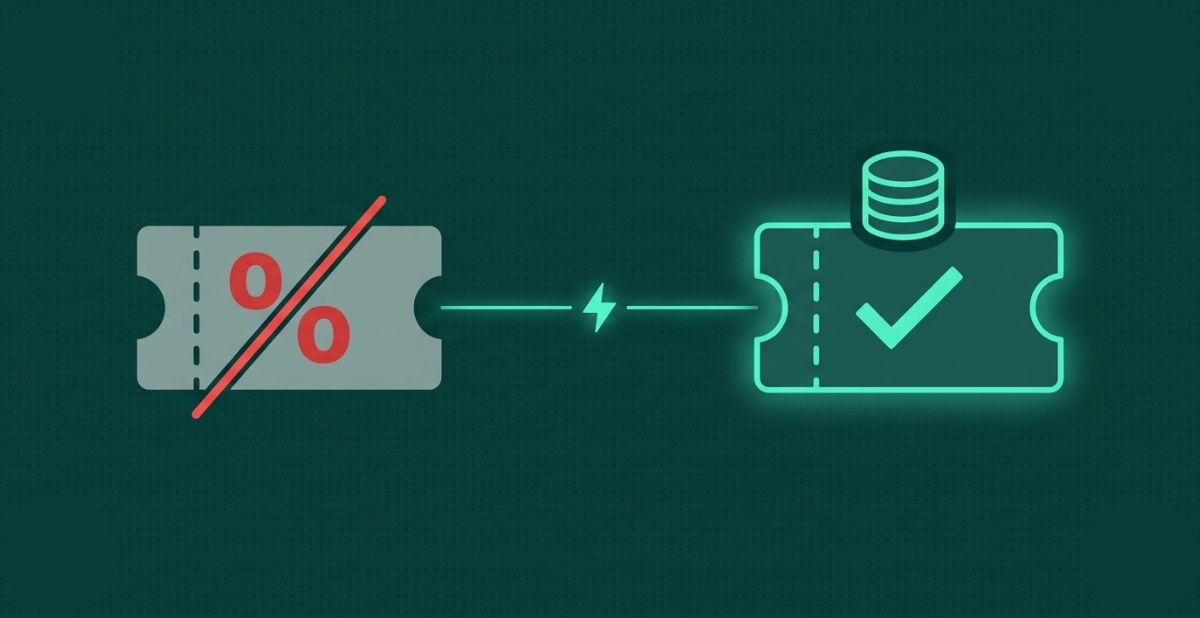
Per-Ticket Fees Explained: Why They're Not Required
Most event platforms charge a fee on every ticket you sell, and organizers have been trained to treat that as unavoidable. It is not. Per-ticket fees are a pricing choice, not a law of the market, and understanding the difference can change how much you keep from every event.
That distinction matters more than it sounds. When the platform earns a cut of each sale, your cost of doing business rises with every success. Sell more, pay more. This article breaks down what per-ticket fees actually cost, why the model became standard, and what changes when you switch to a platform built around direct payment and flat pricing.
How the Industry Made Per-Ticket Fees Feel Normal
Percentage-based ticket fees spread because they suit platforms, not organizers. They scale automatically, they are easy to pitch, and they create revenue that grows every time you sell a ticket. From the platform side, that is an efficient business model.
From the organizer side, it works differently. Raise prices to cover the fee and your audience pays more. Run a tight-margin event and the fee eats a bigger share than you expected. Over years of this, the whole industry started treating platform commissions as a fixed law of ticketing, even though they are only one way to structure the software.
What Per-Ticket Fees Actually Cost You
Numbers make the point faster than theory. Take an illustrative event: 1,000 tickets at 25 euros each, so 25,000 euros in sales.
A typical percentage model of 5 percent plus 0.50 euros per ticket works out to:
- 5 percent of 25,000 euros = 1,250 euros
- 0.50 euros times 1,000 tickets = 500 euros
- Total to the platform: 1,750 euros
Sell 2,000 tickets and that number roughly doubles. Sell 5,000 and it climbs past 8,000 euros. The fee is invisible when you plan the event and very visible when the money lands. A flat monthly subscription behaves the opposite way: the cost is a fixed number you know in advance, and it does not grow just because your event did well.
That gap is the real story. Percentage fees turn your growth into the platform's growth.
Subscription Versus Percentage: Two Different Bets
Choosing a pricing model is really choosing who carries the risk.
With percentage pricing, the platform wins when you win, and you pay for volume you have not yet earned. With a flat subscription, you carry a known fixed cost and keep everything above it. For anyone selling at real volume, or running frequent events, predictable beats convenient almost every time.
Smaller and community organizers feel this most sharply, because a few hundred euros in fees is the difference between an event that funds the next one and one that barely breaks even.
What Direct Payment Changes
Direct payment rewires the relationship between you and the software. Instead of the platform skimming each transaction, money flows straight to your account and the software handles the event infrastructure: ticket creation, sales, validation, attendee management, and check-in.
In practice that gives you:
- Pricing decisions the platform does not tax
- Margins you can forecast before the event
- No per-ticket deduction on any sale
- No feeling of being penalized for selling more
TicketPayGo is built on this model. It runs on your own WordPress site, uses direct payment, and charges a flat subscription instead of a commission on every ticket. You keep your revenue, your customer data, and control of the checkout.
Who Benefits Most From Dropping Per-Ticket Fees
Not every organizer is affected equally. The model matters most if you run higher-volume events, recurring or community events, tight-margin fundraisers, or private events where every euro of margin counts. If you sell only a handful of tickets a year, the fee is a rounding error. If ticketing is central to how you operate, it quietly shapes your entire pricing.
Frequently Asked Questions
Why does my ticketing platform charge per ticket sold? Because a per-sale commission scales revenue automatically for the platform and is simple to present in a sales pitch. It benefits the provider, not the organizer, and it is a choice rather than a technical requirement.
Are per-ticket fees required to sell tickets online? No. Plenty of software runs on a flat subscription or a direct-payment model with no commission per ticket. The fee is a business decision by the platform, not something the technology demands.
What is a per-ticket fee? It is a charge the platform takes on each ticket, usually a percentage of the price plus a small fixed amount, deducted every time you make a sale.
Is a flat subscription cheaper than percentage pricing? It depends on volume. Once you sell enough tickets, a fixed monthly cost is almost always cheaper than a percentage of every sale, and it is far easier to forecast. Run your own numbers using an event you have already sold.
What to Do Next
Take a recent event and calculate what the per-ticket fees cost you, then compare that to a fixed monthly price. If the gap surprises you, it is worth looking closer. See TicketPayGo pricing to see your cost structure without a cut taken from every ticket, or read our comparison of the best WordPress ticketing plugins for 2026 to see how the flat-fee approach stacks up.